A History of Geometric Arena Games: From Asteroids to Geometry Wars to Signal Pitch
Asteroids, Robotron, Geometry Wars, Resogun — why have arena games built out of geometric shapes stayed addictive for decades? An anatomy of the genre.
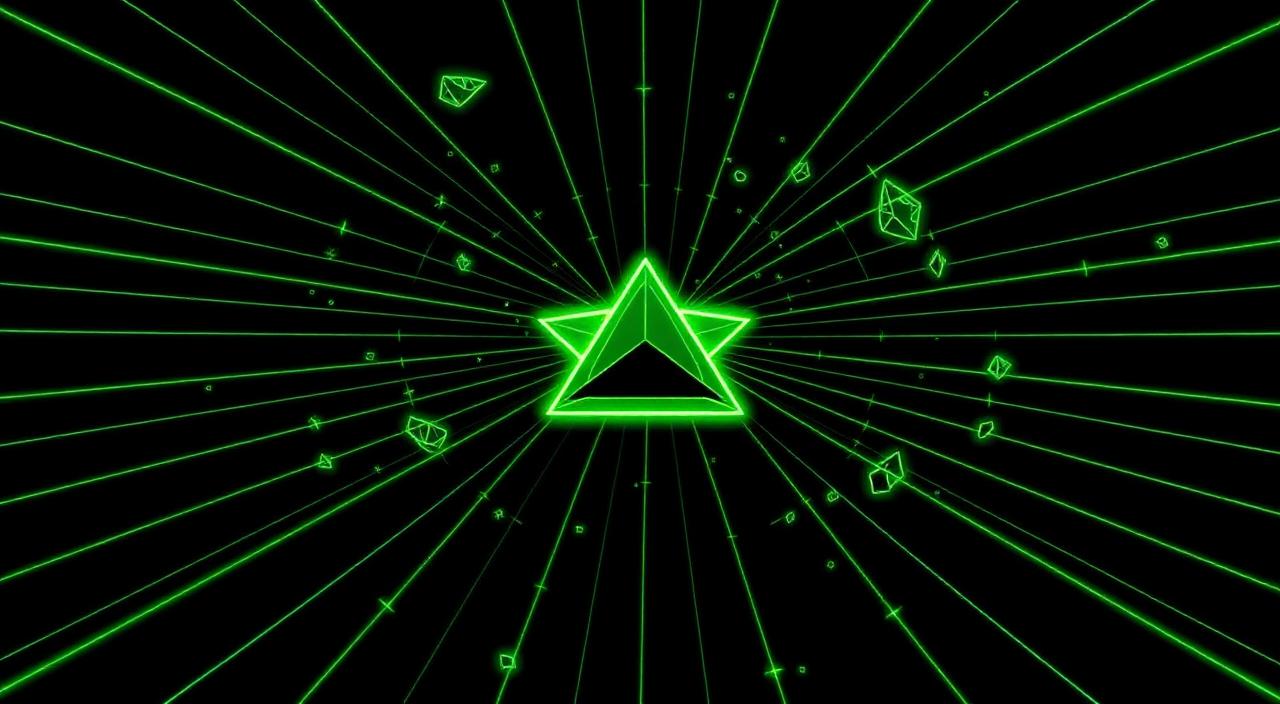
1979. Lyle Rains, an Atari engineer, talks through an idea over coffee with Ed Logg: a triangular ship spinning on screen, polygonal asteroids drifting around it. They drew it with vector graphics — on that hardware, lines were drawn one by one, not pixels. The game was Asteroids. 70,000 cabinets sold. Atari's most successful arcade.
Asteroids invented a genre: the geometric arena. Triangle player, polygon enemies, a closed 2D field, infinitely renewing threat. 45 years later we still play it. This article explains why geometric arena games are such a durable design language — and where Signal Pitch sits in that lineage.
The language Asteroids invented
Asteroids' design rests on four principles, and those four served as the textbook for the next 45 years:
- Single-screen arena: the field is closed; what exits one edge enters the other.
- Geometric enemies: each shape is a threat category. Big asteroid → medium → small (splits on hit).
- Direction + fire: two independent controls; the player picks where they face and where they shoot separately.
- Endless wave: the game doesn't end, the player does. Score-centric progress.
Games that followed those four rules became a genre. The children of Asteroids: Robotron (1982), Geometry Wars (2003), Smash TV (1990), Resogun (2013), Helldivers (2015), Nex Machina (2017), Returnal (2021).
Robotron: 2084 (1982) — the invention of twin-stick
Eugene Jarvis and Larry DeMar split Asteroids' single joystick in two: left stick for movement, right stick for fire. A player could run north while shooting south. That wasn't just a control change — it forced the player's mind to carry two parallel decisions. The "twin-stick shooter" was born.
The power of twin-stick: two sticks, two verbs, infinite combinations. Running upper-left while firing lower-right (4 directions × 8 directions × every second) produces 32 distinct intents per second. That density is the highest decision rate reachable from low input cost.
Geometry Wars: Retro Evolved (2005) — the genre resurrected
Bizarre Creations built Geometry Wars as a small Xbox 360 in-house title, and it carried the genre into the 21st century. Visually TRON-styled (neon grid, vector outlines), mechanically pure twin-stick. Different geometries had different behavior:
- Purple triangle: slowly chases the player.
- Green square: bounces randomly.
- Blue diamond: splits in two when killed.
- Red circular swarms: move together, gather if uncaught.
Each geometry is a behavior signature. The player sees the shape, predicts the behavior, picks their move. This is the purest form of game design: visual = mechanic. No tooltip, low learning curve, no ceiling.
Resogun (2013) and Nex Machina (2017) — the Housemarque school
The Finnish studio Housemarque almost single-handedly carried the genre into the 2010s. Resogun and Nex Machina added two innovations to the geometric arena:
- Voxel particle destruction: thousands of tiny cubes thrown across the screen burst when hit. Visual intensity high, mechanic clean.
- Combo + risk system: a player who stays aggressive without being hit earns higher score multipliers — aggression is rewarded.
Housemarque was later acquired by Sony and pushed the genre to AAA scale with Returnal (2021): roguelike + twin-stick + 3D arena. The geometric arena keeps opening new ground at 40+.
Why is this genre so durable?
The secret of its lifespan is the mechanic's irreducibility. You can't make an Asteroids game simpler — either you remove those three verbs and it stops being a game, or you leave it alone and it remains the textbook. Irreducible design is design without an age.
Tetris, chess, Asteroids — three different dates, three different continents, sharing one secret: few rules, infinite consequences. That is the sacred equality of game design.
The shared muscles of the geometric arena
1. Visual = information
Color and shape must tell the player what kind of danger this is. In Geometry Wars the green square always bounces, the purple triangle always chases. Consistency lets reflex form.
2. Closed field, full screen
Geometric arena games do not scroll. All information is on screen. This forces the player from spatial memory into spatial reading — everything they see is real, no surprise lurks behind the camera.
3. No mechanical tutorial — learn by playing
Open a geometric arena game and there's no tutorial. You die in the first 30 seconds, then you start to understand. This is the onboarding = playing principle, the core rule of minimalist design.
4. Score-centric progression
No story, no levels, no boss. Only score. That ties progress feeling to the player's own performance, not to a gift from the game. This is what deepens addiction.
Signal Pitch and the geometric arena tradition
Signal Pitch isn't a classic twin-stick shooter — its field is borrowed from football. But its design DNA comes from the geometric arena:
- Single screen: the field is closed, no scroll, everything visible.
- Geometric identity: teammate = open geometry, opponent = different geometry, signal = distinguishing color.
- Irreducible mechanic: carry, pass, wait for pressure. Three verbs. Cannot subtract further.
- No tutorial: the player gets it on first match; later matches deepen.
- Score + chain: long pass chains act like the geometric arena's combo system.
The Asteroids player reads three shapes on screen and decides. The Signal Pitch player reads three signal actors on screen and decides. Same mechanical grammar; different dictionary.
Closing: geometry is the first language of games
Asteroids founded a genre in 1979. Geometry Wars revived it in 2003. Returnal pushed it to AAA in 2021. Forty years between them, but the mechanical DNA is identical: shapes-driven, irreducible-decision, single-screen arena.
Signal Pitch is a deliberate member of this lineage. We turned ball into signal, field into arena, score into pass chain. The shapes changed; the grammar held. Because the purest form of game design is geometric — and geometry doesn't age.